Values
A pattern is a trial, not a circulation series. This page is an overview, not a price list.
The mintage chart leaves G, VF, and MS-63 blank. The NGC US Coin Price Guide file retrieved 2026-08-21 does not cover patterns as one series. Do not paste an auction hammer into the grade columns.
If you have one and want to sell it, start with how to sell a coin collection. The Stella is the pattern that already has a page.
Key Dates
Patterns exist across the 19th century and later. A date on a pattern is the trial’s date. It is not a business-strike row of the denomination it resembles.
Errors
Regular coin called a pattern. A circulation design on the right planchet is the series page for that type.
Stella counted twice. Leave the four-dollar pattern on its own page.
Off-metal as a license to invent. An off-metal strike needs its own citation. It does not get a guessed population here.
Varieties
Patterns are trials of a design, a size, or an alloy. Guides number them with Judd numbers. This page does not list every Judd number. The Stella and the Gobrecht dollar already have their own pages.
- Design trialsA proposed portrait or reverse that was not adopted, or not yet adopted. It is not a variety of the circulation coin with the same date.
- Metallurgical trialsA different alloy or planchet, tried on purpose. A copper trial of a gold design is still a pattern.
Names follow PCGS CoinFacts and NGC, the same publishers this site already cites. This is a name list, not a price list and not a count.
Mintage
No combined pattern ledger.
| Year | Mint | Mintage | G | VF | MS-63 |
|---|
Mintage: the note under this table names the page that printed each count. These figures are not an NGC Coin Explorer extract and they are not the 1974 Mint pamphlet.
Collector-standard year/mint presentation follows A Guide Book of United States Coins (the Red Book). These cells are Mint manufacture figures, not a Red Book net or melt.
Values: NGC US Coin Price Guide, retrieved 2026-08-21. Guide values, not offers. Not melt. NGC IDs link to the same publisher’s price-guide listing.
Key date names: PCGS CoinFacts (2026-08-21). Bold rows are only dates that publisher named.
The chart is empty on purpose. Pattern counts are piece by piece. A remembered count does not. The grade columns are empty because this site has no NGC guide extract for this group.
Specifications
These are mint specs, not what a dealer pays. Wear can take a little weight off. We will not invent a tolerance. Patterns do not share one weight or one alloy. No catalog page used here prints a thickness for the whole group.
| Specification | Figure |
|---|---|
| Diameter | Not printed |
| Thickness | Not printed |
| Weight | Not printed |
| Composition | Not printed on a cited catalog page |
| Edge | Not printed on a cited catalog page |
| Designer | The artist changes by trial |
No catalog page used for the patterns overview prints a thickness. Diameter and thickness stay Not printed. Trials do not share one weight or one alloy.
Grading
A pattern wears first on the trial design, which may never have circulated.
The Stella already has a page. A Gobrecht dollar already has three rows. This overview does not recount them.
Key Diagnostic Areas
| Area | What to examine | Why it matters |
|---|---|---|
| Design | The proposed portrait and the proposed reverse, when the trial has both. | A match to a circulation coin is not proof it circulated. |
| Metal | The planchet the trial used. | Off-metal is a fact to cite, not a population to guess. |
| Edge | Plain, reeded, or lettered, as struck. | The edge is part of the experiment. |
| Status | Pattern versus a regular issue. | A business strike belongs on its series page. |
Circulated & Mint State
These cards describe this coin, not a second copy of the P-1 through MS-70 chart. The shared numbers live on the glossary.
What each named grade looks like on this design.
Poor
Poor
A disk you can still call a patterns experimental if you already know the type.
- The trial portrait and the reverse are gone.
- The date may be a shadow. Do not scrape it.
- Shine does not make this a better coin.
AG
About Good
You might read a digit. The high points on this patterns experimental are already slick.
- The trial portrait and the reverse are worn to a blank patch.
- If you cannot read the date without hoping, stay here.
- A pattern is still this grade if it is this worn.
Good
Good
The date is readable. The design is still mostly an outline.
- The trial portrait and the reverse are flat. The type is an outline, not a portrait.
- The rim should be full enough to hold the legend.
- This is a worn coin, not a details story.
VG
Very Good
The date is clear. A little life returns away from the high points.
- Some leftover detail sits away from the trial portrait and the reverse.
- The high points are still tired.
- Do not clean the date to “see it better.”
Fine
Fine
You can follow the design. The high points are outlined, not sharp.
- The trial portrait and the reverse are outlined and flat — no real sharpness yet.
- The rest of the coin can look busier than the grade.
- The date should be clear. The mint mark should be too, if there is one.
VF
Very Fine
The type is doing real work. The trial portrait and the reverse still decide.
- Leftover detail sits on the trial portrait and the reverse. The centers are still the worn spot.
- Marks do not raise the grade.
- A regular pattern is still this grade if it is this worn.
EF
Extremely Fine
Most of the coin looks sharp. The high points tell on it.
- Light wear on the trial portrait and the reverse.
- The rest of the coin can look better than the grade. Trust the high points.
- The date should be sharp.
AU
About Uncirculated
Almost no wear — and “almost” lives on the same high points.
- A trace of rub on the trial portrait and the reverse.
- Luster may still sit in the fields. Rub on those high points is still rub.
- A bright coin with a slick high point is still slick.
Basal MS
Mint State
No wear. The fight is marks and luster, not how white the coin looks.
- No rub on the trial portrait and the reverse.
- Marks and luster decide how this mint-state coin lives.
- A bright chewed-up coin is still chewed-up.
Choice
Choice Mint State
Still no wear. Cleaner fields than basal mint state.
- Same no-wear rule on the trial portrait and the reverse.
- Fewer marks in the fields. Luster is more intact.
- White is not a grade.
Gem
Gem Mint State
A clean patterns experimental for this type. Still mint state, still not a story.
- No wear on the trial portrait and the reverse.
- Marks and luster, not a romance about a date or a white field.
- A slab is an opinion in plastic. The glossary has the numbers.
This page does not invent a PR price grid. The proof numbers live on the glossary.
Copper color designations are not one table for every experimental metal. See the Lincoln Wheat cent and the glossary.
Overview
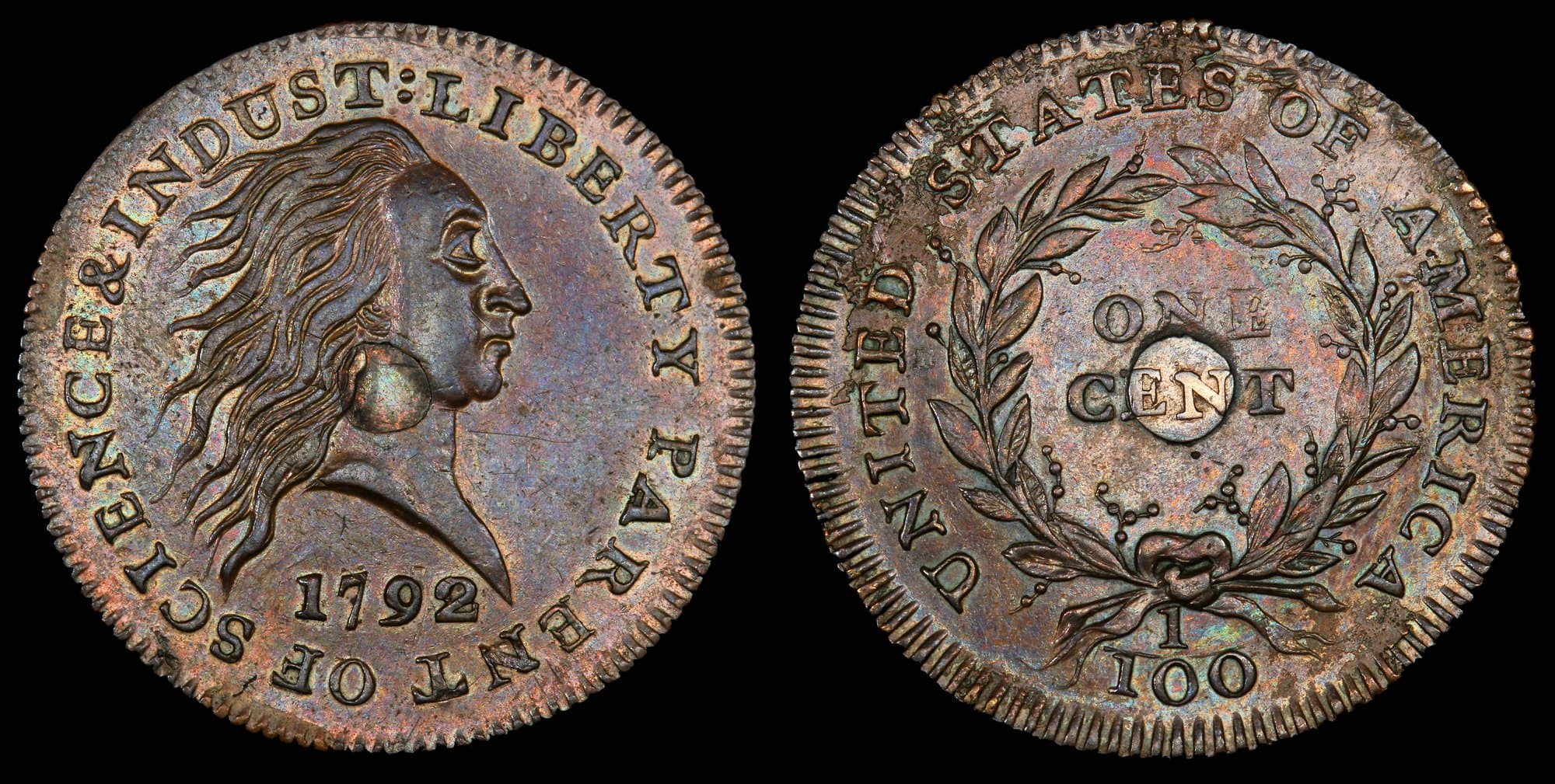
The Mint struck patterns to test a design, a size, or an alloy. Some became regular coins. Most did not. The Red Book keeps them apart from circulation series. This page is that separation. Named pieces that already have pages, above all the Stella, stay on those pages.
No paired public-domain type plate was added. One pattern would not stand for the next.
This page is a series article, not a shop listing.
History
Experimental pieces run from the Mint’s first years through modern trials. A copper trial of a gold design, or a gold trial of a silver design, is still a pattern until Congress and the Mint adopt it. Gobrecht dollars sit on the boundary, which is why they have their own page and their own three rows.
Design
There is no single obverse and reverse. A pattern can propose a portrait, a reverse, or both. Read the denomination the trial proposes, then read whether the adopted coin looks like it. Hairlines on a pattern are often a proof surface, not pocket wear.
People Also Ask
Why is the chart empty?
Patterns are individual experiments. There is no one table of every pattern year that this page can print without inventing the rest.
Is the Stella a pattern?
Yes. It already has its own page because it is a named four-dollar type. This overview does not repeat that chart.
Is a Gobrecht dollar only a pattern?
The Gobrecht page records the original counts the article prints and says which pieces the article treats as patterns. This overview does not re-count them.
How much is a pattern worth?
This page does not print guide prices. The NGC US Coin Price Guide file retrieved 2026-08-21 does not include patterns as a series. An auction result is not a guide cell.
Collector Considerations
Do not file a pattern under the circulation series just because the date matches. Do not file a circulation coin here because it is rare.
Private gold is a different problem. See the private gold overview.
A Final Word
The pattern page is an index of trials, not a mintage table.
An auction story is not a mintage.