Values
A Gobrecht dollar is the 1836–1839 return of the silver dollar, struck in small numbers before the seated dollar. This page is a series reference, not a price list.
The mintage chart leaves G, VF, and MS-63 blank. The NGC US Coin Price Guide file retrieved 2026-08-21 does not cover this piece. Do not paste an auction hammer into the grade columns.
If you have one and want to sell it, start with how to sell a coin collection. The Seated Liberty dollar uses a related obverse from 1840. The Draped Bust dollar is the early dollar this coin replaced after a long pause.
Key Dates
1836 is the first date, including pieces the article says were struck in 1837 still dated 1836. 1839 is the circulation issue with stars removed from the reverse.
1838 is discussed and not counted. Restrikes of the 1850s are a later Mint episode, not an original row.
Errors
Name in the field. C. GOBRECHT F. was moved after complaints. The prominent signature and the smaller one are placement varieties, not two denominations.
1838 invented. The article does not print a figure. The year stays off the chart.
Restrike called an original. A coin made in the 1850s is not the 1836 or 1839 delivery. It is not given a row.
Seated dollar. The perched heraldic eagle of 1840 is the next series. The flying eagle is this one.
Compare the coin to the NGC Coin Explorer. We do not host their plates.
Varieties
Original strikes are the three counts on this chart. The 1850s restrikes are a later Mint episode, and this page already keeps them off the rows. Guides also separate alignment. This page does not count either alignment.
- Original strikesThe 1836 and 1839 deliveries this chart uses. 1838 is discussed and not counted. An original is not a coin made in the 1850s.
- 1850s restrikesMint officials re-struck the coins in the 1850s without authorization, as this page already says. They are not the original production rows.
- Coin turn and medal turnGuides separate eagle alignment: coin turn, and medal turn. Naming the alignment is not a count.
Names follow PCGS CoinFacts and NGC, the same publishers this site already cites. This is a name list, not a price list and not a count.
Mintage
Official counts printed in the Gobrecht dollar article. Originals only.
| Year | Mint | Mintage | G | VF | MS-63 |
|---|---|---|---|---|---|
| 1836 | P 892 | 1,000 1836-dated, old silver standard. Restrikes stay off. | — | — | — |
| 1836 | P 900 | 600 1836-dated, 90 percent silver. Restrikes stay off. | — | — | — |
| 1839 | P | 300 1839 circulation issue. 1838 has no printed count and stays off. | — | — | — |
Mintage: the note under this table names the page that printed each count. These figures are not an NGC Coin Explorer extract and they are not the 1974 Mint pamphlet.
Collector-standard year/mint presentation follows A Guide Book of United States Coins (the Red Book). These cells are Mint manufacture figures, not a Red Book net or melt.
Values: NGC US Coin Price Guide, retrieved 2026-08-21. Guide values, not offers. Not melt. NGC IDs link to the same publisher’s price-guide listing.
Key date names: NGC Coin Explorer. Bold rows are only dates that publisher named.
Two rows are dated 1836 and split by the silver standard the article names. The third row is the 1839 circulation issue. 1838 and the restrikes stay off. The grade columns are empty because this site has no NGC guide extract for this coin.
Specifications
These are mint specs, not what a dealer pays. Wear can take a little weight off. We will not invent a tolerance. Weight and fineness change with the Act of January 18, 1837, so the table says so instead of one figure. No catalog page used here prints a thickness.
| Specification | Figure |
|---|---|
| Diameter | Not printed |
| Thickness | Not printed |
| Weight | 416 grains before the Act of January 18, 1837; 412.5 grains after |
| Composition | 1,485/1,664 silver on the early 1836 strikes; 900 fine after the Act of January 18, 1837 |
| Edge | Not printed on a cited catalog page |
| Designer | Christian Gobrecht, after Thomas Sully and Titian Peale |
No catalog page used for the Gobrecht dollar prints a thickness. Diameter and thickness stay Not printed. Weight and fineness change in 1837. The seated dollar’s heraldic eagle is not this coin.
Grading
A Gobrecht dollar wears first on Liberty’s knee and on the flying eagle.
The size of Gobrecht’s name is a variety. The flying eagle is the type.
Key Diagnostic Areas
| Area | What to examine | Why it matters |
|---|---|---|
| Seated Liberty | The knee, the shield arm, and the rock. | Those high points go first. A heraldic eagle means the later seated dollar. |
| Flying eagle | The eagle among stars, or without them. | Stars on the reverse are a design state, not a grade. |
| Name | C. GOBRECHT F., large or reduced. | The signature moved. It is not a second denomination. |
| Edge | Plain, or with stars, and medal turn or coin turn. | Edge and alignment are striking choices. They are not wear. |
Circulated & Mint State
These cards describe this coin, not a second copy of the P-1 through MS-70 chart. The shared numbers live on the glossary.
See graded photos. The photos that show what VF looks like live at PCGS. We do not host their plates. NGC Coin Explorer is another look if you want a second set.
What each named grade looks like on this design.
Poor
Poor
A disk you can still call a Gobrecht dollar if you already know the type.
- Liberty’s knee and the flying eagle are gone.
- The date may be a shadow. Do not scrape it.
- Shine does not make this a better coin.
AG
About Good
You might read a digit. The high points on this Gobrecht dollar are already slick.
- Liberty’s knee and the flying eagle are worn to a blank patch.
- If you cannot read the date without hoping, stay here.
- A 1836 is still this grade if it is this worn.
Good
Good
The date is readable. The design is still mostly an outline.
- Liberty’s knee and the flying eagle are flat. The type is an outline, not a portrait.
- The rim should be full enough to hold the legend.
- This is a worn coin, not a details story.
VG
Very Good
The date is clear. A little life returns away from the high points.
- Some leftover detail sits away from liberty’s knee and the flying eagle.
- The high points are still tired.
- Do not clean the date to “see it better.”
Fine
Fine
You can follow the design. The high points are outlined, not sharp.
- Liberty’s knee and the flying eagle are outlined and flat — no real sharpness yet.
- The rest of the coin can look busier than the grade.
- The date should be clear. The mint mark should be too, if there is one.
VF
Very Fine
The type is doing real work. Liberty’s knee and the flying eagle still decide.
- Leftover detail sits on liberty’s knee and the flying eagle. The centers are still the worn spot.
- Marks do not raise the grade.
- A regular 1836 is still this grade if it is this worn.
EF
Extremely Fine
Most of the coin looks sharp. The high points tell on it.
- Light wear on liberty’s knee and the flying eagle.
- The rest of the coin can look better than the grade. Trust the high points.
- The date should be sharp.
AU
About Uncirculated
Almost no wear — and “almost” lives on the same high points.
- A trace of rub on liberty’s knee and the flying eagle.
- Luster may still sit in the fields. Rub on those high points is still rub.
- A bright coin with a slick high point is still slick.
Basal MS
Mint State
No wear. The fight is marks and luster, not how white the coin looks.
- No rub on liberty’s knee and the flying eagle.
- Marks and luster decide how this mint-state coin lives.
- A bright chewed-up coin is still chewed-up.
Choice
Choice Mint State
Still no wear. Cleaner fields than basal mint state.
- Same no-wear rule on liberty’s knee and the flying eagle.
- Fewer marks in the fields. Luster is more intact.
- White is not a grade.
Gem
Gem Mint State
A clean Gobrecht dollar for this type. Still mint state, still not a story.
- No wear on liberty’s knee and the flying eagle.
- Marks and luster, not a romance about a date or a white field.
- A slab is an opinion in plastic. The glossary has the numbers.
Originals and restrikes are not the same striking. This page does not invent a PR price grid. The proof numbers live on the glossary.
Copper color designations do not apply to this silver coin. See the Lincoln Wheat cent and the glossary.
Overview
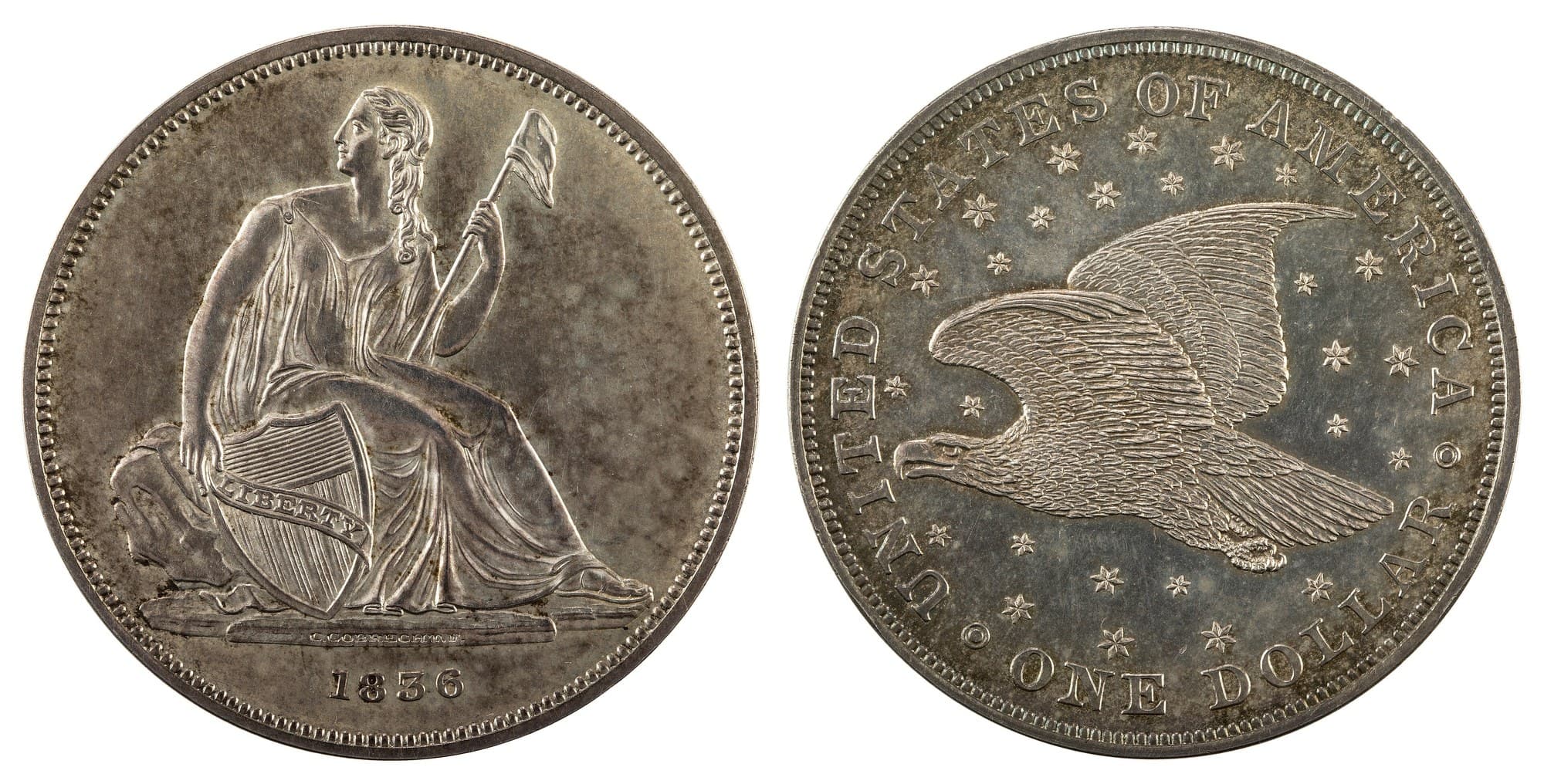
The Gobrecht dollar is the pattern-and-circulation dollar of 1836–1839. Christian Gobrecht engraved Liberty seated, from Thomas Sully, and a flying eagle, from Titian Peale. The coin tested whether the public would take a silver dollar again. The seated dollar of 1840 kept a related obverse and changed the eagle.
The photograph is an 1836 Gobrecht dollar with the name on the base, from the National Numismatic Collection. Later coins move the name. Do not grade every Gobrecht dollar as if it were that plate.
This page is a series article, not a shop listing.
History
Silver dollars had been stopped in the early 1800s because they were exported. In the 1830s the order was lifted and the Mint prepared a new design. The article says 1,000 of the 1836-dated pieces were the old 89.2 percent silver and 600 were the new 90 percent standard, and that 300 dated 1839 were struck for circulation. It also gives a combined original total. This chart uses the three split figures, which add up to that total, and does not add a fourth row for the sum.
The 1850s restrikes are acknowledged and excluded. An unauthorized re-strike is not original production.
Design
Obverse: Liberty seated, with Gobrecht’s name either prominent or reduced. Reverse: a flying eagle, first among stars, later without them. Some edges are plain. Some carry stars. Alignment can be medal turn or coin turn.
The flying eagle is the type. A heraldic eagle is the seated dollar. The size of the name is a variety inside 1836, not a reason to split the standard rows further.
People Also Ask
Why are there three rows?
The Gobrecht dollar article prints an 1836 count at the old silver standard, an 1836-dated count at the new standard, and an 1839 circulation count. Those are the exact figures it gives.
Why is 1838 missing?
The article says a small number dated 1838 were struck and does not print the number. A small number is not a row.
Are restrikes included?
No. The article says Mint officials re-struck the coins in the 1850s without authorization. Restrikes are not the original production rows.
How much is a Gobrecht dollar worth?
This page does not print guide prices. The NGC US Coin Price Guide file retrieved 2026-08-21 does not include this coin. An auction result is not a guide cell.
Collector Considerations
Read the standard before you read the grade. The two 1836 rows are alloy, not two mints. 1839 is the circulation issue in the article. 1838 is real and uncounted here.
A seated dollar with a shield eagle is the Seated Liberty dollar. Do not file it on this chart because the obverse looks related.
Restrikes need a different citation than the original three figures. They do not get one on this page.
A Final Word
The Gobrecht dollar page is three original counts. 1838 and the restrikes stay in the text.
An auction story is not a mintage.