Values
Plenty of Wheat cents are common pocket-change copper. A few dates, mint marks, and errors are worth a dealer’s time. Condition and originality decide more than the word wheat on a folder.
The G, VF, and MS-63 columns sit in the mintage chart below. Those figures are from the NGC US Coin Price Guide, retrieved 2026-08-21. They are a published guide, not an offer and not melt. The chart has a guide cell for each date NGC printed. This pass is the full Wheat series. 1909 is split the way NGC printed it — V.D.B. and no V.D.B. — because the pamphlet does not. 1922 No D is a variety under 1922-D.
If you are trying to turn a jar into a check, read how to sell a coin collection and look at Ohio coin dealers.
Key Dates
These are the dates collectors ask about first. This is a name list, not a price list and not a mintage table. A missing hole in a cheap album is not proof you have one.
- 1909-S V.D.B.
- 1909-S
- 1914-D
- 1922 Plain
- 1931-S
- 1955 Doubled Die
Key date names: PCGS CoinFacts. This is a name list, not a price list.
Key dates are bolded on the mintage chart. Semi-key dates are marked more quietly.
1909 V.D.B. (no mint mark) and 1909-S V.D.B. are not the same conversation. A 1943 steel cent is a composition change, not a key date in the usual sense. A 1943 copper cent, if genuine, is an error, not a restrike.
Errors
A key date is not an error. 1909-S V.D.B. is a variety and a key. It belongs in the list above, not here.
These are the named Wheat errors this page will print. The list is short on purpose. This page will not invent a name or a price.
1922 No D — also called Plain — is a Denver cent that left without a readable D, or with one so weak people argue about it. NGC prints that as No D Strong Reverse. The values sit on that variety row under 1922-D in the chart below.
1955 Doubled Die Obverse is a named PCGS and NGC variety. The date and LIBERTY show the doubled letters. The G / VF / MS-63 cells sit on that variety row under 1955-P in the chart below. The 1974 pamphlet does not split it from the Philadelphia year, so the mintage cell is an em dash.
1943 bronze and 1944 steel are wrong-planchet coins: a 1943 cent struck on leftover bronze, or a 1944 cent struck on leftover steel. NGC printed a VF for 1943-P and 1943-S bronze, and an MS-63 for 1944-P and 1944-D steel. Those grades sit on the variety rows under those year/mint lines. Other grades on those rows stay a dash. 1943-D bronze and 1944-S steel stay name-only; NGC printed no G / VF / MS-63 for them. This page will not invent a mintage.
A usual 1943 steel cent is a composition change, not this error. A 1943 copper, if genuine, is the bronze wrong-planchet coin — not a restrike.
Varieties
These are the design subtypes, the composition change, and the doubled dies collectors sort on Wheat cents. Brown, red-brown, and red are color calls, not varieties. Wrong-planchet coins stay in Errors.
- 1909 V.D.B.Brenner’s initials on the reverse. Philadelphia and San Francisco both exist. The S coin is not the same conversation as the Philadelphia coin.
- 1909 without V.D.B.The Mint pulled the prominent initials. Later 1909 cents have no V.D.B. on the reverse.
- 1922 No DAlso called Plain. A Denver cent that left without a readable D, or with one so weak people argue about it. NGC prints that as No D Strong Reverse.
- 1943 zinc-coated steelThe circulating cent that year is steel, not the usual bronze. It is a composition change. A steel cent that has been re-plated is still a damaged coin.
- 1917 Doubled Die ObverseA doubled die on the date and the portrait. PCGS and NGC both name it. This page does not list every weaker doubled die.
- 1936 Doubled Die ObverseGuides name doubled obverse dies for 1936. The date and LIBERTY are where you look. This is not every 1936 die.
- 1944-D/SA D punched over an S. Guides list it under the Denver date. It is a mint-mark variety, not a second year.
- 1955 Doubled Die ObverseThe date and LIBERTY show the doubled letters. PCGS and NGC both name it. A machine-doubled 1955 is not this die.
Names follow PCGS CoinFacts and NGC, the same publishers this site already cites. This is a name list, not a price list and not a count.
Mintage
Wheat cents were struck at Philadelphia, Denver, and San Francisco during the 1909–1958 run. Not every mint struck every year. The counts below are the pamphlet cells in this repository.
| Year | Mint | Mintage | NGC ID | G | VF | MS-63 |
|---|---|---|---|---|---|---|
| 1909 | P | 115,068,263 Indian + Lincoln not split in the pamphlet. | — | — | — | — |
| 1909 | P V.D.B. | — Pamphlet does not split this variety from the mintage above. | — | $8 | $13 | $45 |
| 1909 | P no V.D.B. | — Pamphlet does not split this variety from the mintage above. | — | $2.50 | $7.50 | $40 |
| 1909 | S | 2,618,000 V.D.B. not split from no-V.D.B. | — | — | — | — |
| 1909 | S V.D.B. | — Pamphlet does not split this variety from the mintage above. | 12426 | $875 | $1,300 | $2,500 |
| 1909 | S no V.D.B. | — Pamphlet does not split this variety from the mintage above. | — | $95 | $160 | $435 |
| 1910 | P | 146,801,218 | 12435 | $2.50 | $7.50 | $40 |
| 1910 | S | 6,045,000 | 12438 | $17.50 | $40 | $155 |
| 1911 | P | 101,177,787 | 12441 | $1 | $6 | $60 |
| 1911 | D | 12,672,000 | 12444 | $7.50 | $40 | $185 |
| 1911 | S | 4,026,000 | 12447 | $35 | $75 | $350 |
| 1912 | P | 68,153,060 | 12450 | $1.75 | $12.50 | $75 |
| 1912 | D | 10,411,000 | 12453 | $10 | $55 | $335 |
| 1912 | S | 4,431,000 | 12456 | $20 | $50 | $335 |
| 1913 | P | 76,532,352 | 12459 | $0.75 | $15 | $75 |
| 1913 | D | 15,804,000 | 12462 | $3.50 | $30 | $250 |
| 1913 | S | 6,101,000 | 12465 | $12.50 | $45 | $350 |
| 1914 | P | 75,238,432 | 12468 | $2 | $17.50 | $100 |
| 1914 | D | 1,193,000 | 12471 | $185 | $575 | $4,650 |
| 1914 | S | 4,137,000 | 12474 | $20 | $35 | $600 |
| 1915 | P | 29,092,120 | 12477 | $5 | $30 | $120 |
| 1915 | D | 22,050,000 | 12480 | $2.50 | $20 | $135 |
| 1915 | S | 4,833,000 | 12483 | $17.50 | $40 | $700 |
| 1916 | P | 131,833,677 | 12486 | $0.75 | $7.50 | $65 |
| 1916 | D | 35,956,000 | 12489 | $1 | $17.50 | $145 |
| 1916 | S | 22,510,000 | 12492 | $2.75 | $20 | $245 |
| 1917 | P | 196,429,785 | 12495 | $0.50 | $5 | $55 |
| 1917 | D | 55,120,000 | 12498 | $2.50 | $17.50 | $150 |
| 1917 | S | 32,620,000 | 12501 | $2.50 | $12.50 | $200 |
| 1918 | P | 288,104,634 | 12504 | $0.20 | $1 | $37 |
| 1918 | D | 47,830,000 | 12507 | $0.75 | $11 | $145 |
| 1918 | S | 34,680,000 | 12510 | $0.35 | $9 | $250 |
| 1919 | P | 392,021,000 | 12513 | $0.22 | $1.15 | $29 |
| 1919 | D | 57,154,000 | 12516 | $0.35 | $8.50 | $115 |
| 1919 | S | 139,760,000 | 12519 | $0.35 | $2.40 | $155 |
| 1920 | P | 310,165,000 | 12522 | $0.30 | $2.25 | $24 |
| 1920 | D | 49,280,000 | 12525 | $0.50 | $7.50 | $145 |
| 1920 | S | 46,220,000 | 12528 | $0.50 | $10 | $220 |
| 1921 | P | 39,157,000 | 12531 | $0.50 | $7 | $75 |
| 1921 | S | 15,274,000 | 12534 | $2 | $12.50 | $230 |
| 1922 | D | 7,160,000 Pamphlet has 1922-D only; 1922 Plain is a variety. | 12537 | $20 | $35 | $190 |
| 1922 | D No D Strong Reverse | — Pamphlet does not split this variety from the mintage above. | — | $700 | $1,000 | $24,500 |
| 1923 | P | 74,723,000 | 12543 | $0.50 | $4.50 | $29 |
| 1923 | S | 8,700,000 | 12546 | $2.50 | $28 | $485 |
| 1924 | P | 75,178,000 | 12549 | $0.25 | $2.50 | $45 |
| 1924 | D | 2,520,000 | 12552 | $30 | $65 | $540 |
| 1924 | S | 11,696,000 | 12555 | $1.50 | $24 | $340 |
| 1925 | P | 139,949,000 | 12558 | $0.15 | $2 | $22 |
| 1925 | D | 22,580,000 | 12561 | $0.75 | $7 | $135 |
| 1925 | S | 26,380,000 | 12564 | $0.75 | $9 | $260 |
| 1926 | P | 157,088,000 | 12567 | $0.15 | $1 | $21 |
| 1926 | D | 28,020,000 | 12570 | $1.50 | $11 | $120 |
| 1926 | S | 4,550,000 | 12573 | $9.50 | $15 | $525 |
| 1927 | P | 144,440,000 | 12576 | $0.15 | $0.75 | $19 |
| 1927 | D | 27,170,000 | 12579 | $0.75 | $6.50 | $105 |
| 1927 | S | 14,276,000 | 12582 | $1 | $4.50 | $190 |
| 1928 | P | 134,116,000 | 12585 | $0.15 | $1 | $16.50 |
| 1928 | D | 31,170,000 | 12588 | $0.75 | $2.60 | $70 |
| 1928 | S | 17,266,000 | 12591 | $0.90 | $9.50 | $160 |
| 1929 | P | 185,262,000 | 12594 | $0.25 | $0.50 | $14 |
| 1929 | D | 41,730,000 | 12597 | $0.50 | $1.75 | $38 |
| 1929 | S | 50,148,000 | 12600 | $0.50 | $2.50 | $33 |
| 1930 | P | 157,415,000 | 12603 | $0.10 | $0.75 | $10.25 |
| 1930 | D | 40,100,000 | 12606 | $0.25 | $1.75 | $28 |
| 1930 | S | 24,286,000 | 12609 | $0.25 | $1.25 | $15 |
| 1931 | P | 19,396,000 | 12612 | $0.75 | $3 | $35 |
| 1931 | D | 4,480,000 | 12615 | $5 | $12 | $90 |
| 1931 | S | 866,000 | 12618 | $85 | $120 | $200 |
| 1932 | P | 9,062,000 | 12621 | $1.50 | $5.50 | $28 |
| 1932 | D | 10,500,000 | 12624 | $1.75 | $3 | $30 |
| 1933 | P | 14,360,000 | 12627 | $2 | $5.75 | $32 |
| 1933 | D | 6,200,000 | 12630 | $3 | $8 | $34 |
| 1934 | P | 219,080,000 | 12633 | $0.15 | $0.35 | $10 |
| 1934 | D | 28,446,000 | 12636 | $0.20 | $0.75 | $21 |
| 1935 | P | 245,388,000 | 12639 | $0.10 | $0.30 | $7 |
| 1935 | D | 47,000,000 | 12642 | $0.15 | $0.35 | $8.50 |
| 1935 | S | 38,702,000 | 12645 | $0.15 | $0.75 | $18.50 |
| 1936 | P | 309,637,569 | 12648 | $0.10 | $0.45 | $4 |
| 1936 | D | 40,620,000 | 12651 | $0.15 | $0.50 | $5.50 |
| 1936 | S | 29,130,000 | 12654 | $0.15 | $0.75 | $7.75 |
| 1937 | P | 309,179,320 | 12657 | $0.15 | $0.45 | $4 |
| 1937 | D | 50,430,000 | 12660 | $0.15 | $0.50 | $7 |
| 1937 | S | 34,500,000 | 12663 | $0.15 | $0.50 | $8 |
| 1938 | P | 156,696,734 | 12666 | $0.15 | $0.40 | $4.75 |
| 1938 | D | 20,010,000 | 12669 | $0.20 | $0.85 | $8.50 |
| 1938 | S | 15,180,000 | 12672 | $0.35 | $0.75 | $8 |
| 1939 | P | 316,479,520 | 12675 | $0.10 | $0.40 | $6.50 |
| 1939 | D | 15,160,000 | 12678 | $0.35 | $0.75 | $5 |
| 1939 | S | 52,070,000 | 12681 | $0.15 | $0.75 | $4.50 |
| 1940 | P | 586,825,872 | 12684 | $0.05 | $0.25 | $2.50 |
| 1940 | D | 81,390,000 | 12687 | $0.05 | $0.50 | $3.25 |
| 1940 | S | 112,940,000 | 12690 | $0.05 | $0.40 | $3.50 |
| 1941 | P | 887,039,100 | 12693 | $0.05 | $0.30 | $2.50 |
| 1941 | D | 128,700,000 | 12696 | $0.05 | $0.55 | $3.50 |
| 1941 | S | 92,360,000 | 12699 | $0.05 | $0.70 | $3.75 |
| 1942 | P | 657,828,600 | 12702 | $0.05 | $0.25 | $2.50 |
| 1942 | D | 206,698,000 | 12705 | $0.05 | $0.35 | $3.50 |
| 1942 | S | 85,590,000 | 12708 | $0.10 | $0.75 | $7 |
| 1943 | P | 684,628,670 | 12711 | $0.05 | $0.30 | $3.25 |
| 1943 | P Bronze | — Pamphlet does not split this variety from the mintage above. | 12712 | — | $60,000 | — |
| 1943 | D | 217,660,000 | 12714 | $0.10 | $0.50 | $7.50 |
| 1943 | S | 191,550,000 | 12717 | $0.10 | $0.55 | $11 |
| 1943 | S Bronze | — Pamphlet does not split this variety from the mintage above. | 13513 | — | $150,000 | — |
| 1944 | P | 1,435,400,000 | 12720 | $0.05 | $0.10 | $1.50 |
| 1944 | P Steel | — Pamphlet does not split this variety from the mintage above. | 12718 | — | — | $62,500 |
| 1944 | D | 430,578,000 | 13514 | $0.05 | $0.05 | $1.50 |
| 1944 | D Steel | — Pamphlet does not split this variety from the mintage above. | 12723 | — | — | $85,000 |
| 1944 | S | 282,760,000 | 12729 | $0.05 | $0.05 | $1.50 |
| 1945 | P | 1,040,515,000 | 12732 | $0.05 | $0.05 | $1.50 |
| 1945 | D | 226,268,000 | 12735 | $0.05 | $0.05 | $1.50 |
| 1945 | S | 181,770,000 | 12738 | $0.05 | $0.05 | $1.50 |
| 1946 | P | 991,655,000 | 12741 | $0.05 | $0.05 | $1.50 |
| 1946 | D | 315,690,000 | 12744 | $0.05 | $0.05 | $1.50 |
| 1946 | S | 198,100,000 | 12747 | $0.05 | $0.05 | $1.50 |
| 1947 | P | 190,555,000 | 12750 | $0.05 | $0.05 | $1.50 |
| 1947 | D | 194,750,000 | 12753 | $0.05 | $0.05 | $1.50 |
| 1947 | S | 99,000,000 | 12756 | $0.05 | $0.05 | $1.50 |
| 1948 | P | 317,570,000 | 12759 | $0.05 | $0.05 | $1.50 |
| 1948 | D | 172,637,500 | 12762 | $0.05 | $0.05 | $1.50 |
| 1948 | S | 81,735,000 | 12765 | $0.05 | $0.05 | $1.50 |
| 1949 | P | 217,775,000 | 12768 | $0.05 | $0.05 | $1.50 |
| 1949 | D | 153,132,500 | 12771 | $0.05 | $0.05 | $1.50 |
| 1949 | S | 64,290,000 | 12774 | $0.05 | $0.05 | $1.50 |
| 1950 | P | 272,686,386 | 12777 | $0.05 | $0.05 | $1.50 |
| 1950 | D | 334,950,000 | 12780 | $0.05 | $0.05 | $1.50 |
| 1950 | S | 118,505,000 | 12783 | $0.05 | $0.05 | $1.50 |
| 1951 | P | 284,633,500 | 12786 | $0.05 | $0.05 | $1.50 |
| 1951 | D | 625,355,000 | 12789 | $0.05 | $0.05 | $1.50 |
| 1951 | S | 136,010,000 | 12792 | $0.05 | $0.05 | $1.50 |
| 1952 | P | 186,856,980 | 12795 | $0.05 | $0.05 | $1.50 |
| 1952 | D | 746,130,000 | 12798 | $0.05 | $0.05 | $1.50 |
| 1952 | S | 137,800,004 | 12801 | $0.05 | $0.05 | $1.50 |
| 1953 | P | 256,883,800 | 12804 | $0.05 | $0.05 | $1.50 |
| 1953 | D | 700,515,000 | 12807 | $0.05 | $0.05 | $1.50 |
| 1953 | S | 181,835,000 | 12810 | $0.05 | $0.05 | $1.50 |
| 1954 | P | 71,873,350 | 12813 | $0.05 | $0.05 | $1.50 |
| 1954 | D | 251,552,500 | 12816 | $0.05 | $0.05 | $1.50 |
| 1954 | S | 96,190,000 | 12819 | $0.05 | $0.05 | $1.50 |
| 1955 | P | 330,958,200 | 12822 | $0.05 | $0.05 | $1.50 |
| 1955 | P Doubled Die Obverse | — Pamphlet does not split this variety from the mintage above. | 12825 | $1,200 | $1,725 | $3,875 |
| 1955 | D | 563,257,500 | 12828 | $0.05 | $0.05 | $1.50 |
| 1955 | S | 44,610,000 | 12831 | $0.05 | $0.05 | $1.50 |
| 1956 | P | 421,414,384 | 12834 | $0.05 | $0.05 | $1.50 |
| 1956 | D | 1,098,201,100 | 12837 | $0.05 | $0.05 | $1.50 |
| 1957 | P | 283,787,952 | 12840 | $0.05 | $0.05 | $1.50 |
| 1957 | D | 1,051,342,000 | 12843 | $0.05 | $0.05 | $1.50 |
| 1958 | P | 253,400,652 | 12846 | $0.05 | $0.05 | $1.50 |
| 1958 | D | 800,953,300 | 12849 | $0.05 | $0.05 | $1.50 |
Mintage: United States, Bureau of the Mint, Domestic and Foreign Coins Manufactured by Mints of the United States, 1792-1965 (Washington, D.C.: GPO, 1974). Publisher: FRASER / GPO pamphlet.
Collector-standard year/mint presentation follows A Guide Book of United States Coins (the Red Book). These cells are Mint manufacture figures, not a Red Book net or melt.
Values: NGC US Coin Price Guide, retrieved 2026-08-21. Guide values, not offers. Not melt. NGC IDs link to the same publisher’s price-guide listing.
Key date names: PCGS CoinFacts (2026-08-21). Bold rows are only dates that publisher named.
NGC ID: NGC Coin Explorer listing number, retrieved 2026-08-21. A dash means this pass did not record an ID. 1909-S V.D.B. has an ID. Other 1909 splits stay a dash.
These are Bureau of the Mint manufacture figures from the 1974 GPO pamphlet in this repository, not a Red Book net or melt. The grade columns in the same box are NGC guide values from 2026-08-21, not an offer. The NGC ID column is the Coin Explorer listing for that date when this pass recorded one. 1909-S V.D.B. has an ID. Other 1909 splits stay a dash. 1909 Philadelphia is Indian Head plus Lincoln, not split in the pamphlet. 1909-S does not split V.D.B. from no-V.D.B. The pamphlet has 1922-D only; 1922 No D sits as a variety under that row, with an em dash in the mintage cell. 1955 Doubled Die Obverse, 1943 bronze, and 1944 steel sit the same way under their year/mint. The chart has a guide cell for each date NGC printed. This pass is the full series.
Composition is not mintage. The usual bronze Wheat cent is mostly copper. 1943 is steel. Some mid-1940s cents used recycled brass. None of that is a count we typed from memory.
Specifications
These are mint specs, not what a dealer pays. Wear can take a little weight off. We will not invent a tolerance.
The usual Wheat cent is bronze. 1943 is zinc-coated steel. That year is a composition change, not a key date. A steel cent is not copper melt.
| Specification | Figure |
|---|---|
| Diameter | 19.05 mm (0.750 in) |
| Thickness | 1.4 mm usual bronze; 1.5 mm in 1943 |
| Weight | 3.11 g usual bronze; 2.70 g in 1943 |
| Composition | Usual bronze is 95% copper, 5% tin and zinc. 1943 is zinc-coated steel. Some 1944–1946 cents are leftover brass: 95% copper, 5% zinc. |
| Edge | Plain |
| Designer | Victor David Brenner |
Diameter is the U.S. Mint circulating-cent figure. Weight and bronze composition are as struck for this series, not the current zinc-cent spec. Thickness 1.4 mm is the Numista bronze Wheat type page (N#908, KM# 132). 1943 steel thickness 1.5 mm is the Numista steel type page (N#3173, KM# 132a). The current zinc circulating-cent thickness is not this series.
Grading
A Wheat cent wears first on the wheat heads and the lines in the stalks, on Lincoln’s hair and cheekbone, and on the date. Those are the spots to read before you argue about color.
Copper color — brown, red-brown, or red — is a color call, not a numeric grade. 1909 V.D.B. versus no V.D.B. is a variety. So is 1922 Plain. Neither one is a grade.
Key Diagnostic Areas
| Area | What to examine | Why it matters |
|---|---|---|
| Wheat heads and stalks | The lines in the wheat ears and the stalks on the reverse. | The heads go slick first. If the lines are gone, the coin has been in a pocket. |
| Lincoln’s hair and cheekbone | The hair above the ear and the cheekbone on the portrait. | Those high points flatten while the coat still looks busy. |
| The date | The numerals under LIBERTY, and the mint mark under the date when there is one. | A worn date is a worn coin. Do not clean it to “see the date better.” |
| Copper color and spots | Remaining original red, carbon spots, fingerprints, and PVC film. | BN, RB, and RD describe color, not a number. A dipped “red” coin is not red in the way a collector means it. |
Circulated & Mint State
These cards describe this coin, not a second copy of the P-1 through MS-70 chart. The shared numbers live on the glossary.
See graded photos. The photos that show what VF looks like live at PCGS. We do not host their plates. Compare the coin in hand to PCGS Photograde. NGC Coin Explorer is another look if you want a second set.
What each named grade looks like on this design.
Poor
Poor
Lincoln is a silhouette. You know it is a wheat cent because you already knew the type.
- The wheat heads and stalks are gone. No lines left to read.
- Hair and cheekbone are a blank. The date may be a shadow.
- Do not scrub copper to force the date. That is damage, not a grade.
AG
About Good
The date is barely there. The high points are already slick.
- Wheat heads are worn smooth. Stalks are a faint outline.
- Lincoln’s hair and cheekbone are gone.
- If you cannot read the date without hoping, stay here.
Good
Good
The date is readable. The design is still mostly an outline.
- Wheat stalks are outlined. The heads have no real lines.
- Lincoln’s hair is a mass. The cheekbone is flat.
- A readable date does not make the wheat sharp.
VG
Very Good
The date is clear. A little life returns in the stalks.
- Some lines come back in the wheat stalks. The heads are still tired.
- Hair starts to separate from a flat mass.
- The cheekbone is still worn. Color is not the question yet.
Fine
Fine
You can follow the wheat and the portrait. The high points are outlined, not sharp.
- Wheat heads show leftover lines. The stalks are easier to trace.
- Hair and cheekbone are outlined, not crisp.
- The date is clear. Do not clean it to “see it better.”
VF
Very Fine
The wheat is doing real work. The high points still decide.
- Lines in the stalks are easy to see. The heads keep leftover detail.
- Leftover strands in Lincoln’s hair. The cheekbone is not slick.
- A 1909 with or without V.D.B. is still this grade if it is this worn.
EF
Extremely Fine
Most of the cent looks sharp. The wheat heads and the cheekbone tell on it.
- Light wear on the wheat heads, the hair, and the cheekbone.
- The date is sharp. The mint mark under the date, if there is one, should be too.
- Color is still a different conversation. Brown can already be honest.
AU
About Uncirculated
Almost no wear — and “almost” lives on the wheat, the hair, and the cheekbone.
- A trace of rub on the wheat heads and on Lincoln’s hair and cheekbone.
- The date should be full. Luster may remain in the protected spots.
- Spots and fingerprints already matter. Copper does not forgive a damp basement.
Basal MS
Mint State
No wear. Color is a color call, not a number.
- No rub on the wheat heads, the hair, the cheekbone, or the date.
- BN, RB, and RD describe remaining original red. Brown can be honest.
- A dipped “red” coin is not red in the way a collector means it.
Choice
Choice Mint State
Still no wear. Cleaner copper than basal mint state.
- Same no-wear rule on the wheat, the hair, and the date.
- Fewer spots and fingerprints. PVC film from cheap pages still ruins a coin.
- Color is still BN, RB, or RD — not an extra numeric grade.
Gem
Gem Mint State
Clean copper with the wheat lines and the hair intact.
- No wear, and the high points still have their lines.
- Color remains a color call. This page does not invent a 1955 doubled-die census.
- A slab is an opinion in plastic. The glossary has the color names.
Proof Wheat cents exist for some years. Cameo contrast belongs on those proofs. This page does not invent wheat proof mintages. The proof numbers live on the glossary.
Copper color
BN, RB, and RD describe remaining original color on uncirculated copper. They are not extra numeric grades. The names also live on the glossary.
| Code | Name | Remaining original red |
|---|---|---|
| RD | Red | 95% or more of the original red remains |
| RB | Red-Brown | 5% to 95% of the original red remains |
| BN | Brown | Less than 5% of the original red remains |
Overview
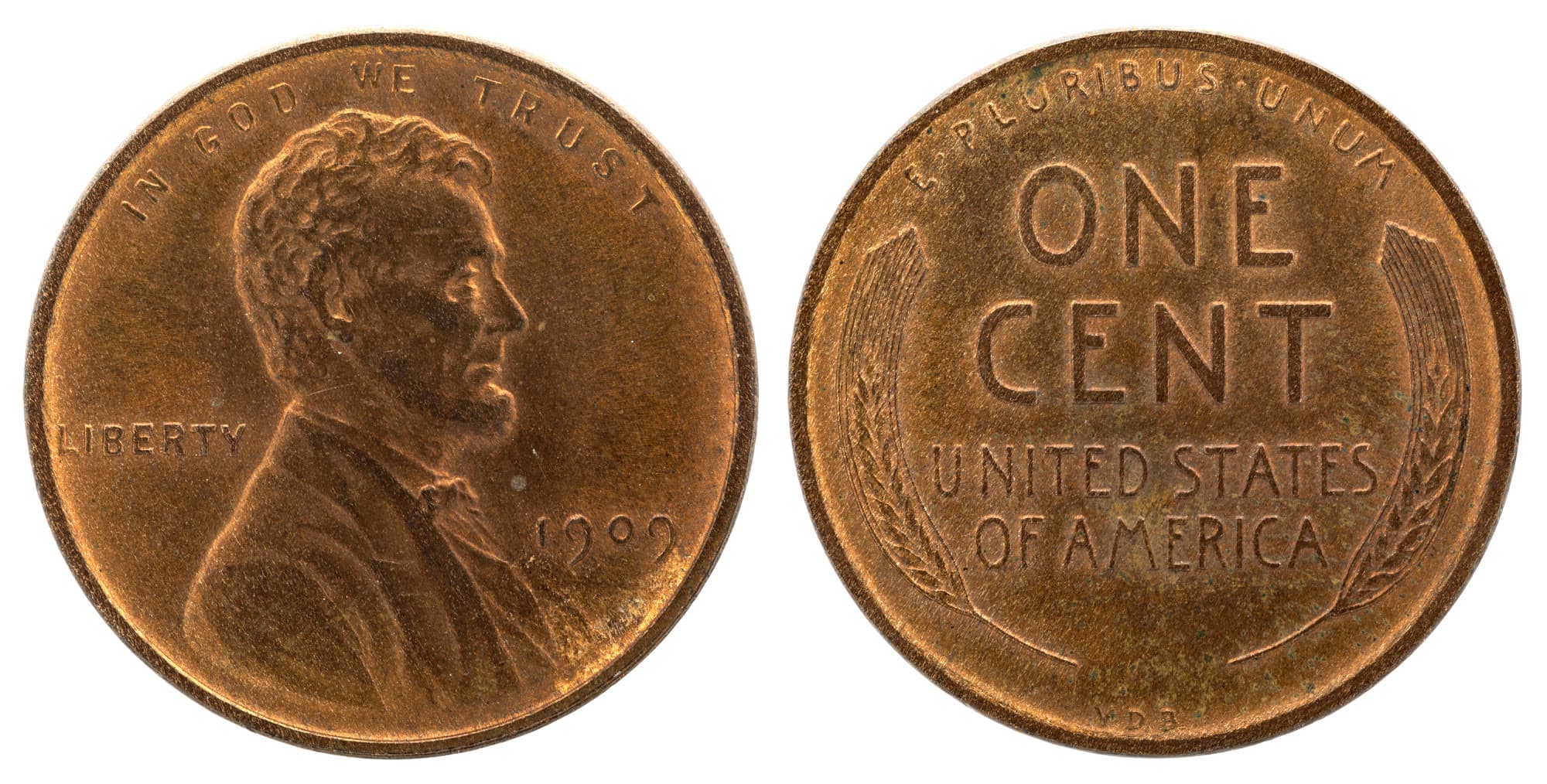
A Lincoln Wheat cent is the one-cent coin with Abraham Lincoln on the front and two wheat ears on the back. The United States struck them for circulation from 1909 through 1958. After that the reverse changes, and people stop calling the coin a wheat penny.
Most of the ones in coffee cans are ordinary. That is allowed. A series can be common and still be worth learning, because the same design also includes famous varieties, a steel year, and copper color that collectors actually pay attention to.
This is a reference article. It is not a shop, and it is not a price guide.
History
1909 is the Lincoln cent’s first year and the end of the Indian Head cent. It is also the first regularly circulating United States coin to show a real president. Victor David Brenner designed it. His initials, V.D.B., appear on the reverse of some 1909 coins and then become a public argument. The Mint pulled the prominent initials. Later they come back, smaller, on Lincoln’s shoulder.
From there the series is a long, ordinary American object: pennies in drawers, folders with holes, and kids who thought a 1909 looked old because it was. Two interruptions matter for identification. In 1943 the circulating cent is zinc-coated steel. In 1959 the wheat reverse is gone and the Memorial reverse takes its place.
There are no official restrikes of Wheat cents in this series. A later Memorial cent is a later design. A 1943 copper cent, if genuine, is an error, not a restrike. This page will not pretend to authenticate one from a photograph you have not shown anyone.
Design
Obverse: Lincoln facing right, “IN GOD WE TRUST,” “LIBERTY,” and the date. Reverse: two wheat stalks, “ONE CENT,” “UNITED STATES OF AMERICA,” and “E PLURIBUS UNUM.”
Mint marks, when present, sit below the date. No mint mark means Philadelphia. D is Denver. S is San Francisco.
Brenner’s initials are the variety most people ask about first. 1909 V.D.B. and 1909-S V.D.B. are not the same conversation. The S coin is the one people get excited about. Excitement is not a substitute for looking at the letters under a lamp.
Wheat cents also pick up carbon spots, fingerprints, and PVC damage from cheap pages. Copper does not forgive a damp basement.
People Also Ask
What years are wheat pennies?
Lincoln Wheat cents were struck for circulation from 1909 through 1958. In 1959 the reverse changes to the Lincoln Memorial.
Are wheat pennies worth anything?
Plenty of them are common and trade as pocket-change copper. A few dates, mint marks, and errors are worth a dealer’s time. Condition and originality decide more than the word wheat on a folder.
What is a 1943 steel cent?
In 1943 the circulating Lincoln cent was struck in zinc-coated steel instead of the usual copper alloy. It is a wartime composition change, not a restrike, and a steel cent that has been re-plated or rusted is still a damaged coin.
What do BN, RB, and RD mean on a Lincoln cent?
Those are copper color designations. BN is brown, RB is red-brown, and RD is red. They describe remaining original color on uncirculated copper. They are not extra numeric grades.
Where is the mint mark on a wheat cent?
On Wheat cents the mint mark sits on the obverse, under the date. Philadelphia coins have no mint mark. Denver uses D. San Francisco uses S.
Collector Considerations
A folder of Wheat cents is a start, not a census. Fill holes if that is the fun. Do not assume a missing date in a cheap album is a key date in the wild.
If you have a 1909 with initials, a 1914-D, a 1922 plain, or a 1955 doubled die, do not clean it to “see the date better.” Take it to a dealer. The directory is the place this site will send you, beginning with Ohio. No invented shop names.
Steel 1943 cents rust. Copper-plated steel fakes exist. A magnet is a clue, not a certificate.
For the cent this one replaced, read the Indian Head cent page. For a silver series with a different set of problems — bag marks instead of carbon spots — read the Morgan dollar.
A Final Word
Wheat cents are the coins people actually find. That is the charm and the trap. Most are common. A few are not. The way you tell the difference is the date, the mint mark, and whether someone has already scrubbed the copper to death.
The Indian Head cent is the copper series that came before this one. For silver instead of copper, use the Morgan dollar.