Values
A Native American dollar’s market depends on the year, the reverse, the mint, and the grade. This page is a series reference, not a price list.
The G, VF, and MS-63 columns sit in the mintage chart below. Those figures are from the NGC US Coin Price Guide, retrieved 2026-08-23. They are a published guide, not an offer and not melt. A blank cell means that grade was not printed in this pass. The 2000–2008 eagle reverse is not this page. NGC lists both in one subcategory.
A dealer looking at the coin in hand will beat a guide number. If you are trying to sell a pile of them, start with how to sell a coin collection and the Ohio coin dealer directory.
Key Dates
PCGS CoinFacts and NGC named no traditional key-date list for this series in this pass. This page will not invent one.
There is no key-date bolding on the mintage chart for that reason. A worn common date is still worn.
Errors
These are named varieties. This page will not invent a count.
2000–2008 eagle reverse. A different series. Not this page.
Missing edge lettering. A variety conversation on later small dollars. This chart does not invent a count.
Compare the coin in hand to the NGC Coin Explorer listing. We do not host their plates.
Varieties
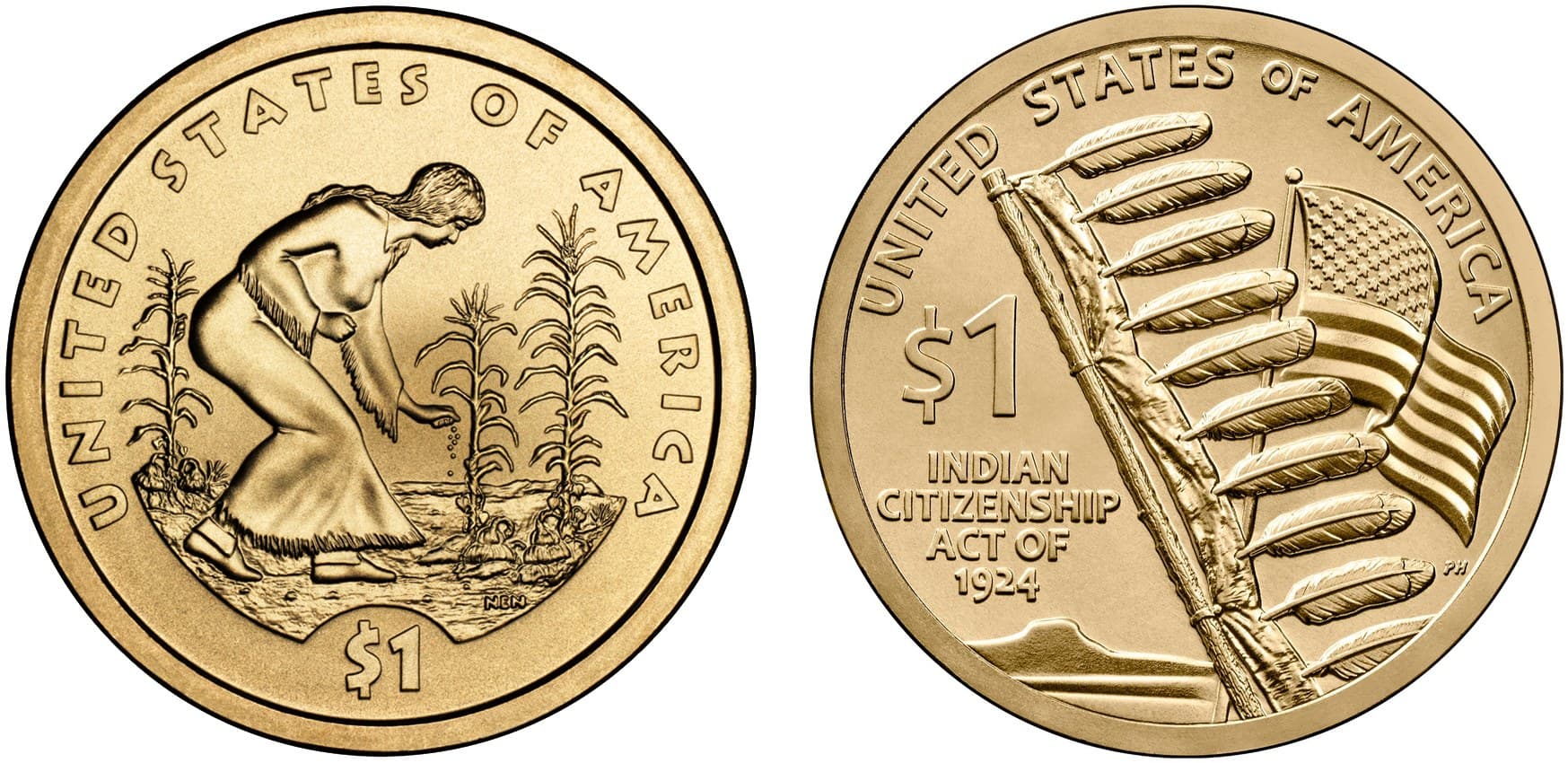
Each year has its own reverse. The portrait stays Sacagawea. Edge lettering is part of the coin from 2009 on. This page does not list every reverse theme as if it were a die chip.
- Yearly reverseThe theme changes with the year. Read the reverse before you match a date. It is a design, not a doubled die.
- 2009 edge position A and position BThe date and mint mark on the edge sit in two orientations. Guides name position A and position B. They are edge styles, not two portraits.
Names follow PCGS CoinFacts and NGC, the same publishers this site already cites. This is a name list, not a price list and not a count.
Mintage
Native American dollars were struck at Philadelphia and Denver for circulation. The counts below are the NGC Coin Explorer business-strike cells that printed a mintage in this pass.
| Year | Mint | Mintage | NGC ID | G | VF | MS-63 |
|---|---|---|---|---|---|---|
| 2009 | P THREE SISTERS | 37,380,000 | — | — | — | — |
| 2009 | D THREE SISTERS | 33,880,000 | — | — | — | — |
| 2010 | P GREAT LAW OF PEACE | 32,060,000 | — | — | — | — |
| 2010 | D GREAT LAW OF PEACE | 48,720,000 | 824048 | $1.05 | $1.05 | $2.50 |
| 2011 | D WAMPANOAG TREATY | 48,160,000 | 824055 | $1.05 | $1.05 | $2.50 |
| 2011 | P WAMPANOAG TREATY | 29,400,000 | 824053 | $1.05 | $1.05 | $2.50 |
| 2012 | P 17th CENTURY TRADE ROUTES | 2,800,000 | 824060 | $1.05 | $1.05 | $2.50 |
| 2012 | D 17th CENTURY TRADE ROUTES | 3,080,000 | — | — | — | — |
| 2013 | D TREATY WITH | 1,820,000 | 824128 | — | — | — |
| 2013 | P TREATY WITH | 1,820,000 | 824125 | $1.05 | $1.05 | $2.50 |
| 2014 | P NATIVE HOSPITALITY | 3,080,000 | — | — | — | — |
| 2014 | D NATIVE HOSPITALITY | 5,600,000 | 824292 | $1.05 | $1.05 | $2.50 |
| 2015 | D MOHAWK IRONWORKERS | 2,240,000 | 824357 | $1.05 | $1.05 | $2.50 |
| 2015 | P MOHAWK IRONWORKERS | 2,800,000 | 824354 | $1.05 | $1.05 | $2.50 |
| 2016 | P CODE TALKERS | 2,100,000 | — | — | — | — |
| 2016 | D CODE TALKERS | 2,800,000 | — | — | — | — |
| 2017 | P SEQUOYAH | 3,020,736 | — | — | — | — |
| 2017 | D SEQUOYAH | 2,737,136 | — | — | — | — |
| 2018 | P JIM THORPE | 1,400,000 | — | — | — | — |
| 2018 | D JIM THORPE | 1,400,000 | — | — | — | — |
| 2019 | P INDIANS IN SPACE | 1,400,000 | — | — | — | — |
| 2019 | D INDIANS IN SPACE | 1,540,000 | — | — | — | — |
| 2020 | P ELIZABETH PERATROVICH | 1,400,000 | — | — | — | — |
| 2020 | D ELIZABETH PERATROVICH | 1,260,000 | — | — | — | — |
| 2021 | P INDIANS IN THE MILITARY | 1,260,000 | — | — | — | — |
| 2021 | D INDIANS IN THE MILITARY | 1,260,000 | — | — | — | — |
| 2022 | P ELY S. PARKER | 980,000 | — | — | — | — |
| 2022 | D ELY S. PARKER | 980,000 | — | — | — | — |
Mintage: NGC Coin Explorer, retrieved 2026-08-23. A blank year in the prose is a year NGC did not print. These are Explorer manufacture figures, not a Red Book net or melt.
Collector-standard year/mint presentation follows A Guide Book of United States Coins (the Red Book). These cells are Mint manufacture figures, not a Red Book net or melt.
Values: NGC US Coin Price Guide, retrieved 2026-08-23. Guide values, not offers. Not melt. NGC IDs link to the same publisher’s price-guide listing.
Key date names: NGC Coin Explorer. Bold rows are only dates that publisher named.
NGC ID: NGC Coin Explorer listing number, retrieved 2026-08-21. A dash means this pass did not record an ID.
2009 through 2022 Philadelphia and Denver business strikes are on this chart. 2023 and later stay off until a per-mint figure is published in a source this chart can cite. 2000–2008 eagle-reverse coins live on the Sacagawea page. SMS, satin, proof, and West Point listings are not rows here. The grade columns in the same box are NGC guide values from 2026-08-23, not an offer.
Read the edge date. Read the reverse. Look at the cheek before you argue a 2000 eagle.
Specifications
These are mint specs, not what a dealer pays. Wear can take a little weight off. We will not invent a tolerance.
A Native American dollar is manganese-brass clad with edge lettering. The 2000–2008 eagle reverse has a plain edge and is not this page.
| Specification | Figure |
|---|---|
| Diameter | 26.5 mm |
| Thickness | 2 mm |
| Weight | 8.1 g |
| Composition | manganese-brass clad copper |
| Edge | Lettered |
| Designer | Glenna Goodacre obverse; changing Native American reverses |
Thickness 2 mm, weight 8.1 g, and diameter 26.5 mm are the Numista Native American type page figures (N#9953, 2010 Haudenosaunee). Edge lettering is this series. The 2000–2008 eagle reverse is not this page.
Grading
A Native American dollar wears first on Sacagawea’s cheek and on the year’s reverse devices. Edge lettering is part of the type, not a grade.
This page starts in 2009. The 2000–2008 eagle reverse lives on the Sacagawea page. NGC lists both in one subcategory. This page will not combine them.
Key Diagnostic Areas
| Area | What to examine | Why it matters |
|---|---|---|
| Sacagawea’s cheek | The cheekbone and the hair by the infant. | Those high points flatten while the fields can still look busy. |
| Year’s reverse | The changing Native American reverse for that year. | The reverse devices go slick first. The theme is not a grade. |
| Edge lettering | Date, mint mark, and motto on the edge. | Missing or weak edge lettering is a variety conversation, not a higher grade. |
| Date | The date on the edge, not under the portrait. | A worn or unread edge date is still a worn dollar. Do not scrape the edge. |
Circulated & Mint State
These cards describe this coin, not a second copy of the P-1 through MS-70 chart. The shared numbers live on the glossary.
See graded photos. The photos that show what VF looks like live at PCGS. We do not host their plates. NGC Coin Explorer is another look if you want a second set.
What each named grade looks like on this design.
Poor
Poor
A disk you can still call the Native American dollar if you already know it.
- The high points are gone.
- The date may be a shadow.
- Do not invent a variety at this wear.
AG
About Good
You might read a digit. The high points are already slick.
- The design is an outline.
- If you cannot read the date without hoping, stay here.
- Look at the type before you name a variety.
Good
Good
The date is readable. The design is still mostly an outline.
- The high points are flat.
- Leftover field detail does not save it.
- This is a worn coin, not a details story.
VG
Very Good
The date is clear. A little life returns away from the high points.
- Some leftover detail comes back.
- The high points are still tired.
- Do not clean the date to see it better.
Fine
Fine
You can follow the design. The high points are outlined, not sharp.
- The type is readable.
- The high points are not crisp.
- The date should be clear.
VF
Very Fine
The design is doing real work. The high points still decide.
- Leftover detail sits away from the cheek and reverse devices.
- The center of the cheek and reverse devices is still the worn spot.
- A pretty tone does not hide a slick high point.
EF
Extremely Fine
Most of the coin looks sharp. The high points tell on it.
- Light wear on the same high points.
- The rest of the coin can look better than the grade.
- Trust the cheek and reverse devices.
AU
About Uncirculated
Almost no wear — and almost lives on the same spots.
- A trace of rub on the cheek and reverse devices.
- Luster may still sit in the fields.
- A bright slick high point is still rub.
Basal MS
Mint State
No wear. The fight is marks and luster.
- No rub on the cheek and reverse devices.
- Marks and luster decide how this mint-state coin lives.
- A bright chewed coin is still chewed.
Choice
Choice Mint State
Still no wear. Cleaner fields than basal mint state.
- Same no-wear rule on the cheek and reverse devices.
- Fewer marks in the fields.
- A slab is an opinion in plastic.
Gem
Gem Mint State
Clean high points and fields. Still mint state, still not a story.
- No wear on the cheek and reverse devices.
- Marks and luster, not a romance copied onto MS-63.
- The glossary has the numbers.
Proof Native American dollars exist. This page does not invent a PR price grid — NGC did not print one in the 2026-08-23 sheet used here. The proof numbers live on the glossary.
Copper color designations (BN, RB, RD) do not apply here. Those belong on copper coins such as the Indian Head cent. See the Lincoln Wheat cent and the glossary.
Overview
A Native American dollar is a United States dollar coin with Sacagawea on the front and a changing Native American reverse each year from 2009. Collectors mean 2009 to date. People still say Sacagawea. That portrait is shared. The reverse and the edge are this series.
People like them because the reverses give you something to sort. They are also easy to ruin. A wiped dollar looks “better” to a seller and worse to everyone else.
This page is a series article, not a shop listing.
History
Congress set a Native American reverse program beginning in 2009. The portrait stays. The reverse changes. NGC still files these with the 2000–2008 eagle reverse. This site will not.
This page will not invent a shop list to fill the years between.
Design
Obverse: Sacagawea facing right with Jean Baptiste, LIBERTY, and IN GOD WE TRUST. Reverse: that year’s Native American design and ONE DOLLAR. Edge: date, mint mark, and motto.
Look at the cheek, the reverse devices, and the edge. A plain edge with an eagle is the earlier series.
People Also Ask
What years are Native American dollars?
The program starts in 2009. This chart runs through 2022. NGC counts stay as printed. The years NGC left blank, including 2009, are Wikipedia Philadelphia and Denver business strikes. 2023 and 2024 do not have a per-mint figure on the page we used, so they stay off.
How much is a Native American dollar worth?
It depends on the year, the reverse, the mint, and the grade. The G, VF, and MS-63 columns in the mintage chart are NGC guide values from 2026-08-23, not an offer. A dealer looking at the actual coin will beat a guide number.
Is this the same page as Sacagawea 2000–2008?
No. The eagle reverse is its own page. NGC lists both in one subcategory. This site splits them.
Why is 2009 missing?
2009 Three Sisters is on the chart. Both mints are the Wikipedia circulation figures. This page will not invent a later year that has no per-mint count.
Where is the date?
On the edge, with the mint mark and the motto. That is this series. The 2000–2008 eagle reverse puts the date on the obverse.
Collector Considerations
Buy the coin, not the story.
If you inherited a box, do not scrub the date to “see it better.” Keep them in the holders they arrived in, or in cheap cardboard flips, and take the box to a person who sees this series every week. The coin dealer directory starts in Ohio. This site does not invent shop names to fill a paragraph.
Raw coins are fine. So are slabs. What is not fine is a coin that has been cleaned until the fields look like glass, then offered as “original.”
If you collect by type, one honest circulated 2011 will teach you the cheek and the edge. For the eagle reverse, read the Sacagawea dollar.
A Final Word
These coins reward people who slow down. Read the date. Read the mint mark. Leave the polish under the sink.
When you want the eagle reverse, the Sacagawea dollar is already here.